
How AI Search Is Changing Website Traffic and Measurement in 2026
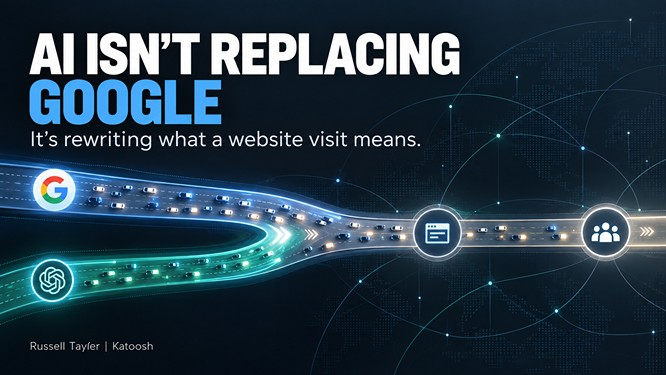
AI search is not replacing Google. It is adding another discovery layer between a customer's question and the website visit businesses traditionally measure. Current data shows ChatGPT growing rapidly while Google remains dominant, AI-generated answers reducing clicks on some searches, AI assistants creating referrals in others, and analytics tools improving without yet providing a complete customer-journey view.
Is AI replacing Google?
No. The current evidence points more strongly toward addition than simple replacement.
Semrush's latest U.S. website ranking, updated through July 2026, estimates Google received 25.31 billion monthly visits, compared with approximately 1.09 billion for ChatGPT. ChatGPT nevertheless ranked ninth and grew 48.38% year over year, making it a substantial discovery platform in its own right.
Similarweb has also reported that 95% of ChatGPT users in its measured audience continued to use Google. That overlap was the same in September 2025 and May 2026. For businesses, the implication is important: customers are increasingly using search engines and AI assistants as parts of the same research process rather than choosing one permanently over the other.
What do the latest website-traffic numbers show?
Semrush estimates that Google received 25.31 billion U.S. visits in July 2026, YouTube 10.27 billion and Reddit 2.61 billion. The top 10 websites represented 68.6% of visits among Semrush's top 150 sites, while the top three represented 54.3%.
ChatGPT recorded approximately 1.09 billion visits and was up 48.38% year over year. Bing.com, by contrast, recorded approximately 530.6 million visits and was down 50.43% year over year.
Website visits should not be confused with search-engine usage share. Statcounter's August 2026 U.S. data estimates Google at 86.1% of search-engine usage and Bing at 8.92%. A decline in visits to Bing.com therefore does not mean Bing lost the same percentage of search activity.
Why comparison periods matter
LinkedIn provides a useful example of how easy it is to misread traffic statistics. Semrush shows LinkedIn at approximately 473.7 million U.S. visits in July, up 15.48% month over month but down approximately 6% year over year.
Both percentages are accurate. They answer different questions.
Businesses should always identify the comparison period before interpreting a traffic increase or decline.
Do Google AI Overviews reduce website clicks?
Research suggests that AI-generated answers can reduce clicks to external websites for searches where those answers appear.
Pew Research Center analysed 68,879 Google searches collected in April 2025. Users clicked a traditional search result on 8% of visits where an AI summary appeared, compared with 15% of visits without an AI summary.
A 2026 randomized field experiment by Saharsh Agarwal and Ananya Sen found that, conditional on an AI Overview appearing, outbound organic clicks fell 39.8% and zero-click searches increased 34.5%. The research remains a working paper and should not be treated as a universal percentage for every query or website.
A separate preregistered experiment published in August 2026 with 1,100 participants also found that removing Google's AI features increased click-through to publishers, while an AI Mode-only experience reduced publisher click-through.
Google has presented aggregate data from a different perspective. In August 2025, the company said total organic click volume from Google Search to websites had remained relatively stable year over year while the average quality of those clicks had increased.
These findings can coexist. AI-generated answers may reduce clicks for individual searches while total search activity, query volume and the distribution of traffic also change.
Can ChatGPT send traffic to business websites?
Yes. AI assistants can reduce clicks in some situations and create them in others.
Similarweb studied a change ChatGPT made on May 7, 2026, when brand links became more prominent inside answers. Across its tracked desktop panel, ChatGPT referrals increased 157.7% week over week and homepage referrals increased 354.7%.
Before the change, approximately 26% to 32% of ChatGPT referrals in the panel landed on company homepages. Afterward, the figure moved to around 60%. Average page views per visit rose from 3.8 to 4.7 and average time on site increased from 3.5 to 3.9 minutes.
The measurement period was short and the figures came from a third-party desktop panel, so they should be treated as directional evidence rather than universal conversion benchmarks.
The larger lesson is that AI interface design can materially change whether an assistant acts mainly as an answer destination or also as a discovery and referral channel.
How should businesses measure AI search traffic?
No single analytics report currently provides a complete picture. Businesses should combine conventional search data, AI visibility, referral traffic, customer feedback and commercial results.
1. Use GA4's AI Assistant channel
Google Analytics introduced a dedicated AI Assistant channel on May 13, 2026. Recognised AI-assistant referrals can now receive the ai-assistant medium and appear in the AI Assistant default channel group.
Review sessions, engagement, conversions and landing pages from this channel, but do not assume it captures every journey influenced by AI.
2. Do not assume Direct traffic means AI traffic
Google describes (direct) / (none) as traffic without a clear referral source. It can include genuine direct visits, missing campaign tags, redirects, offline documents and other situations where referral information is unavailable.
A rise in Direct traffic may justify investigation. It is not evidence by itself that AI caused the increase.
3. Use Search Console's generative-AI reporting
Google says its dedicated Search Console generative-AI performance reporting rolled out worldwide on August 31, 2026. The reporting provides a dedicated view of visibility within generative Search experiences such as AI Overviews and AI Mode.
This improves visibility measurement, but impressions are not the same as enquiries, customers or revenue.
4. Measure branded demand
Track searches containing your business name, product names and other distinctive brand terms. A customer may learn about the business through an AI assistant and later reach the website through a branded Google search.
In that situation, the final session can be recorded as conventional search even though AI played an earlier discovery role.
5. Ask customers directly
Add a simple free-text question to enquiry forms, sales calls or onboarding:
How did you first hear about us?
Customer answers can reveal combinations of channels that digital attribution cannot reconstruct reliably.
What does AI search visibility mean for SEO and AEO?
SEO remains important because Google remains a dominant discovery platform and because many of the fundamentals that make information useful to search engines also make a business easier for AI systems and people to understand.
However, the job is expanding.
A business now benefits from clear entity information, useful content, credible authorship, structured data, accurate local and company information, strong source authority and pages that answer the questions customers ask during research.
Answer Engine Optimization, or AEO, does not require abandoning SEO. It extends the visibility problem to environments where an AI system may synthesise the answer before the customer reaches a conventional results page.
Learn more about SEO and Answer Engine Optimization services.
Why the homepage matters again
Similarweb's ChatGPT referral study provides an interesting practical lesson: after the May 2026 link change, a much larger share of tracked referrals landed on company homepages.
Businesses should therefore review whether a first-time visitor can quickly determine:
- what the company does;
- who it serves;
- where it operates;
- why it is credible;
- which products or services matter;
- what the visitor should do next.
A sophisticated AI visibility strategy cannot compensate for a homepage that leaves a qualified visitor wondering what the company actually does.
Should a website opt out of Google's AI search features?
Google now provides a Search Console control that allows site owners to include or exclude their content from AI Overviews, AI Mode and generative-AI features in Discover.
Google says exclusion prevents the site's links and content from appearing in those generative features but does not act as a ranking or inclusion signal for other parts of Google Search.
There is no universal answer to whether a business should opt out. The decision should consider current AI visibility, referral value, publishing economics, brand goals and the role that search discovery plays in the organisation.
For most commercial businesses seeking visibility, the first step should be measurement and diagnosis rather than changing the setting blindly.
What should businesses measure in 2026?
A practical AI-search scorecard should combine:
- organic search performance;
- AI-answer visibility;
- Search Console generative-AI impressions;
- AI referral sessions;
- branded-search demand;
- qualified enquiries and sales;
- CRM source information;
- customer-reported discovery sources;
- conversion rate and revenue.
Traffic remains useful, but it is an intermediate metric rather than the final business result.
Frequently Asked Questions
Is AI replacing Google Search?
No. AI assistants are growing rapidly, but Google remains much larger in web traffic and search usage. Current audience-overlap data also shows widespread use of both Google and ChatGPT.
Do AI Overviews reduce organic clicks?
Multiple studies indicate lower outbound click-through when AI summaries or AI-focused search experiences appear. The effect varies by query and study, so no single percentage should be applied universally.
Can ChatGPT generate website traffic?
Yes. Similarweb measured a sharp increase in ChatGPT referrals after a May 2026 interface change made brand links more prominent. The study demonstrates that AI assistants can function as referral channels when their design encourages clicking.
Does Direct traffic in GA4 mean the visit came from AI?
No. Direct traffic means GA4 lacks a clear referral source and can have many causes. AI may be one source of unattributed influence, but Direct traffic alone does not prove it.
What is the best way to measure AI search visibility?
Combine GA4, Search Console, AI visibility checks, branded-search trends, CRM information, customer-source surveys, conversions and revenue rather than relying on one metric.
The practical conclusion
SEO is not disappearing. Its job description is expanding.
Businesses need to remain visible in conventional search while also becoming understandable to AI systems that increasingly help customers research products, services and companies.
The objective is not to chase every new platform. It is to make the business clear, credible and easy to discover wherever the customer's research begins.
At Katoosh, the starting point is to examine the complete system—website, search visibility, AI visibility, structured information, customer journey and business outcomes—before deciding what needs to change.
Diagnostic first. Solution second.
Talk to Russell Tayler at Katoosh about your website and AI search visibility.
Sources
- Semrush — Most Visited Websites in the United States, July 2026
- Pew Research Center — Americans and AI 2026
- Pew Research Center — Google AI summaries and click behaviour
- Similarweb — ChatGPT referral traffic analysis
- Google Analytics — AI Assistant traffic measurement
- Google Search Central — Generative AI performance reports
- Google Search Console — Search generative AI control